Most food storage containers make you choose. Plastic is light but degrades and may leach toxins. Glass is inert but heavy, fragile and often comes with a plastic lid. Stainless steel is durable and non-toxic, but not microwave-safe, or so the assumption goes. This guide covers what that assumption gets right, where it falls short, what to look for in a food storage container that actually holds up to daily use, and why a tempered glass lid and uniquely engineered steel change the calculation for stainless steel containers.

The Microwave Safe Container Problem

The microwave-safe question is the first one most people ask about stainless steel food storage, and the answer is more specific than the general warning suggests.

Standard stainless steel is not microwave safe. Solid, unmodified steel reflects microwave energy instead of allowing it to pass through, which can cause arcing and damage the appliance. This applies to most stainless steel containers, lids, plates and bowls on the market, including most of the Greenvyne range. For the full science on why, read Can You Microwave Stainless Steel?

The Greenvyne stainless steel food storage containers are different. The steel base is purpose-engineered for microwave use, a design distinction that most standard stainless steel containers on the market do not have. Independently tested and certified by SGS, one of the world's leading accredited testing and certification bodies, for safe use in both the microwave and the oven. The result is a container that goes from the fridge to the microwave without a detour through another dish. Remove the glass lid before microwaving.

If you are on this page, you are not choosing between steel and steel. You are choosing between stainless steel, plastic, glass with a plastic lid, and glass with a glass lid. Here is the honest comparison.

Stainless Steel, Plastic and Glass: The Honest Comparison

Swipe to compare →

Greenvyne Steel + Glass Lid Plastic Glass + Plastic Lid Standard Stainless Steel
Microwave safe ✓ Steel base, SGS tested. Remove lid before use. ✓ Most grades, with lid on △ Glass body yes. Remove plastic lid first. ✗ Not microwave safe
Oven safe ✓ Steel base to 200°C. Remove lid. ✗ No △ Glass body only. Remove plastic lid. △ Base only, varies by brand
Freezer safe ✓ Yes, airtight silicone seal △ Yes, degrades over time ✓ Yes ✓ Yes
Food safe ✓ Inert steel, LFGB silicone, tempered glass △ BPA-free grades available but microplastic and PFAS risk remains △ Glass body inert. Plastic lid in food zone during reheating. ✓ Inert, non-reactive
Microplastic risk ✓ None. No plastic in the food zone. ✗ Present under heat and mechanical stress △ Plastic lid present during storage and reheating ✓ None
See contents without opening ✓ Tempered glass lid △ Some clear grades, discolours over time △ Depends on lid opacity ✗ No
Unbreakable △ Steel base yes. Glass lid handle with care. △ Cracks under stress ✗ Glass body shatters on impact ✓ Dents before it shatters
Odour and stain resistant ✓ Non-porous steel, does not absorb either ✗ Absorbs odours and stains over time ✓ Glass body yes ✓ Yes
Dishwasher safe ✓ All parts, top rack, no degradation △ Warps and clouds over time ✓ Yes ✓ Yes
Nesting storage ✓ All three sizes nest together △ Varies by brand ✗ Rarely △ Varies by brand
Independent lab tested ✓ SGS tested, finished product ✗ Rarely on finished product ✗ Rarely on finished product ✗ Rarely on finished product
Lifespan ✓ Decades ✗ 1–2 years typical △ 3–5 years ✓ Decades

Key: ✓ Advantage  ·  △ Conditional  ·  ✗ Limitation
The microwave row is the most important one on this table. Standard stainless steel cannot be microwaved. The Greenvyne steel base has been independently tested by SGS for microwave use. The glass lid is removed before microwaving — consistent with standard guidance for any sealed container, and clearly printed on the packaging.

Built Differently. Independently Tested.

A tempered glass lid does something a silicone or solid steel lid cannot: it shows you exactly what is inside without breaking the seal. When your fridge holds several containers of meal-prepped food, identifying the right one at a glance is a small thing that compounds across every meal of the week.

The lid is designed around a high-performance LFGB-certified food-grade silicone seal and a manual vent plug. The vent plug is what makes the seal work properly. As the lid seats, the vent allows air to escape so the silicone compresses flush against the steel rim without resistance. To open, release the vent plug to equalise the pressure, and the lid lifts away cleanly. It is a mechanical solution designed to perform consistently across the full temperature range your containers move through, from the freezer to the fridge to the bench.

Greenvyne food storage containers are designed to do what most stainless steel containers cannot: go from the fridge to the microwave without a detour through another dish. The 304-grade steel base has been uniquely engineered and independently tested by SGS, one of the world's leading accredited testing and certification bodies, for safe use in both the microwave and the oven.

The steel base is rated for oven temperatures up to 200°C. The tempered glass lid is designed for fridge and freezer use. No BPA, BPS or phthalates. No plastic on the food contact surface. No internal coatings. A pure material, independently tested, doing exactly what it is rated to do.

At a Glance

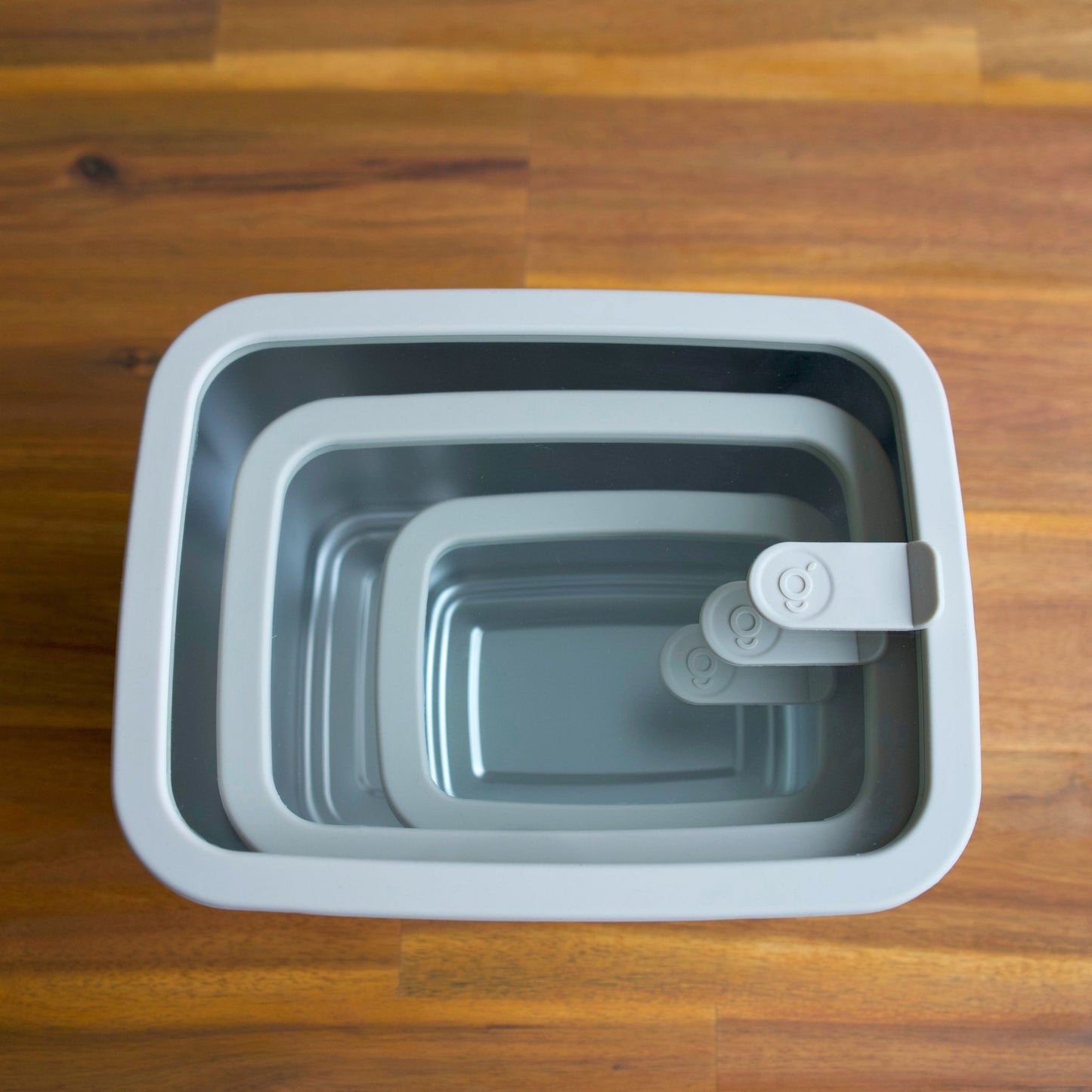
  • 3-piece set: 600ml, 1500ml and 2900ml
  • 304-grade stainless steel base, SGS tested for microwave and oven use
  • Tempered glass lid with LFGB-certified silicone seal and vent plug
  • Nesting design for compact cupboard storage
  • Steel base microwave safe with lid removed, oven safe to 200°C
  • Freezer safe and top-rack dishwasher safe, all parts

What to Look For Before You Buy
On stainless steel grade

Not all stainless steel food storage containers are the same grade. 202 and 204-grade steel is a lower-cost alloy with less nickel and more manganese than 304-grade stainless steel. It is more susceptible to corrosion over time, particularly with acidic foods like tomato-based sauces, citrus dressings and vinegar. Many containers sold on marketplace platforms are 202 or 204-grade without stating it clearly.

304-grade stainless steel, also written as 18/8 or SUS304, is the correct specification for food storage used daily with varied foods. It is the alloy used in commercial kitchens and hospital catering. It does not corrode under normal food contact conditions, requires no internal coating, and does not change composition with age or repeated dishwasher use. If the grade is not stated on the product page, it is worth asking.

On silicone grade

Silicone appears on food storage containers as lid seals, full silicone lids, and flexible components. The quality varies, and the labelling is inconsistently used.

Domestic food-grade silicone is the minimum manufacturing standard. FDA food-grade silicone meets the US standard for food contact materials. LFGB food-grade silicone meets the German Food and Feed Code standard, the European benchmark, and is widely considered the most stringent internationally. It applies stricter migration limits than the FDA and requires testing of the finished product in its final form.

Greenvyne uses LFGB-certified silicone on all seals, independently tested on the finished product. When a brand states "food-grade silicone" without specifying the standard, LFGB is the question worth asking.

On microwave use with stainless steel

Using a stainless steel container in a microwave safely requires a few specific conditions. These are printed in full on the Greenvyne packaging, and they are worth understanding before use, regardless of which brand you buy.

Remove the lid before microwaving. Centre one container at a time and ensure it does not touch the microwave walls. Reheat in 60-second increments at a maximum of 1000W. Do not exceed five minutes total reheating time per use. Always ensure adequate liquid is present in the container before microwaving. Do not microwave a container with dents or surface damage, as surface irregularities can affect how the container interacts with microwave energy. Do not place metal utensils inside the container during microwaving. The container will be hot: use oven mitts or a towel when handling.

These are standard operating conditions for a purpose-designed microwave-safe metal container.

From Batch Cook Sunday to Thursday Night Reheating

The size range in this set was chosen around real meal volumes. The 600ml container handles a single meal portion, a generous salad, a bowl of soup, or a serving of pasta. The 1500ml handles a family meal portion, a batch of curry, or a full dinner's worth of roasted vegetables. The 2900ml handles a full pot of bolognese, a large batch of grains, or anything you have cooked for the week and want sealed and stacked in the fridge until needed.

All three nest inside each other for storage. One shelf in the cupboard. Three containers are ready to go. No tower of mismatched and cracked lids and no drawer full of things that no longer match.

The practical workflow for most households looks like this. Cook in bulk on a weekend. Portion into containers while still warm, open the vent, seat the lid, and close the vent. Refrigerate or freeze. Midweek, open the vent, lift the lid off, and place the steel base in the microwave. Sixty-second intervals, oven mitts for handling, done. One container goes from the fridge to the microwave to the table without anything else getting dirty.

The glass lid is why this works better than a silicone-only lid for fridge use. You can see what is in each container without opening it. Three containers of different meals are clearly visible from the front of the fridge shelf. The one you want is obvious before you touch anything.

For freezer storage, the silicone seal closes flush and airtight, which means less air in the container and better protection against freezer burn than a loose-fitting lid. Defrost overnight in the fridge, reheat in the base the following day. The steel handles the temperature range without warping, cracking or taking on any odour from whatever was previously stored in it.

Complete the Plastic-Free Kitchen System

The food storage containers are designed to work alongside the rest of the Greenvyne range. For packed lunches and on-the-go portions, the stainless steel lunch box and dip pot set covers the daytime. For smaller portions and school snacks, the stainless steel snack box guide covers the 200ml two-compartment format that fits alongside a sandwich in any standard Australian lunch bag. For the full mealtime picture at home, explore the stainless steel dinnerware collection.

For the science behind why most stainless steel cannot be microwaved and what makes purpose-engineered containers different, read Can You Microwave Stainless Steel? If you reheat food in plastic regularly, Microplastics in Your Kitchen: What the Research Actually Says covers what the current evidence shows and why the heated plastic question matters separately from BPA.

Everything in the Greenvyne range is food-grade 304 or 316-grade steel, LFGB-certified silicone, and built to the same testing standard.

Can you put stainless steel in the microwave?

Most stainless steel is not microwave safe. Metal reflects microwave energy, which can cause arcing and damage the appliance. If you need a microwave-safe option, look for containers specifically engineered and tested for microwave use. The Greenvyne food storage containers are different: the steel base has a unique design and is independently tested by SGS for microwave use under specific operating conditions. The glass lid is removed before microwaving. Reheat in 60-second increments at max 1000W, one container at a time, centred, with liquid present in the container. Full instructions are on the packaging and in the care guide above.

What does SGS tested mean?

SGS is one of the world's leading accredited testing and certification laboratories. An SGS test run on the finished product means the actual container, as sold, was tested under real-use conditions, not a material sample or a supplier specification sheet. The steel base of these containers was tested by SGS for both microwave and oven use. The silicone seal was tested for food contact safety to LFGB standards.

Why is the lid not microwave safe?

The glass lid was not submitted for microwave testing. The instruction is to remove the lid before microwaving, which is standard practice for any sealed container, regardless of material. We tested what we could stand behind, and we stated the scope of that test clearly.

Are these oven safe?

The steel base is oven safe to 200°C for up to 45 minutes per use. The glass lid does not go in the oven. Use oven mitts when handling.

Are these freezer safe?

Yes. The airtight silicone seal performs across the full temperature range from freezer to room temperature. Defrost overnight in the fridge before microwaving. Allow the container to come to room temperature briefly before placing a frozen container in the microwave.

What is the vent plug for?

The vent plug allows air to escape as the lid seats, so the LFGB-certified silicone seal closes flush and airtight without resistance. To put the lid on, open the vent, press the lid down, and close the vent. To remove the lid, open the vent to release the pressure and lift the lid off cleanly. The vent needs to be open before microwaving, at which point the lid is removed entirely.

Is there any plastic in these containers?

No. The base is 304-grade stainless steel. The lid is tempered glass. The seal is LFGB-certified silicone. There is no plastic anywhere in the food contact zone.

What sizes are included?

The set includes three rectangular containers: 600ml, 1500ml and 2900ml. All three nest inside each other for compact storage. Each container has its own tempered glass lid with LFGB-certified silicone seal and vent plug.

What is LFGB certification?

LFGB is the German Food and Feed Code that sets the European standard for food contact materials. It is widely regarded as the most stringent food contact standard internationally, stricter than equivalent Australian and US requirements. An LFGB test is run on the finished product by an accredited laboratory, testing for migration of substances into food under realistic conditions. Greenvyne uses LFGB-certified silicone across all seals and lids in the range.

Are these dishwasher safe?

Yes. All parts, including the glass lid, silicone seal and steel base, are top-rack dishwasher safe. Use mild detergent and a low-heat cycle to protect the silicone seal and finish. Hand washing is recommended for the longest life.

How is this different from a glass food storage container with a glass lid?

The steel base is unbreakable, whereas a glass base is not. It is lighter than an equivalent glass container. It does not stain or absorb odours. The microwave guidance is the same for both: remove the lid before microwaving. The difference is that the Greenvyne steel base was independently tested by SGS for microwave use, which is not standard practice for most glass containers sold in Australia.